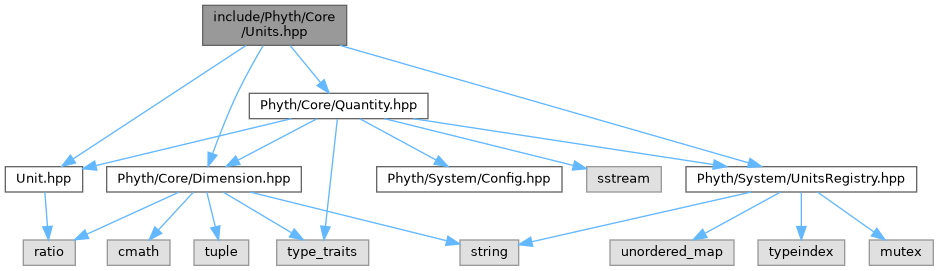
#include "Phyth/Core/Dimension.hpp"#include "Phyth/System/UnitsRegistry.hpp"#include "Unit.hpp"#include "Phyth/Core/Quantity.hpp"
Include dependency graph for Units.hpp:
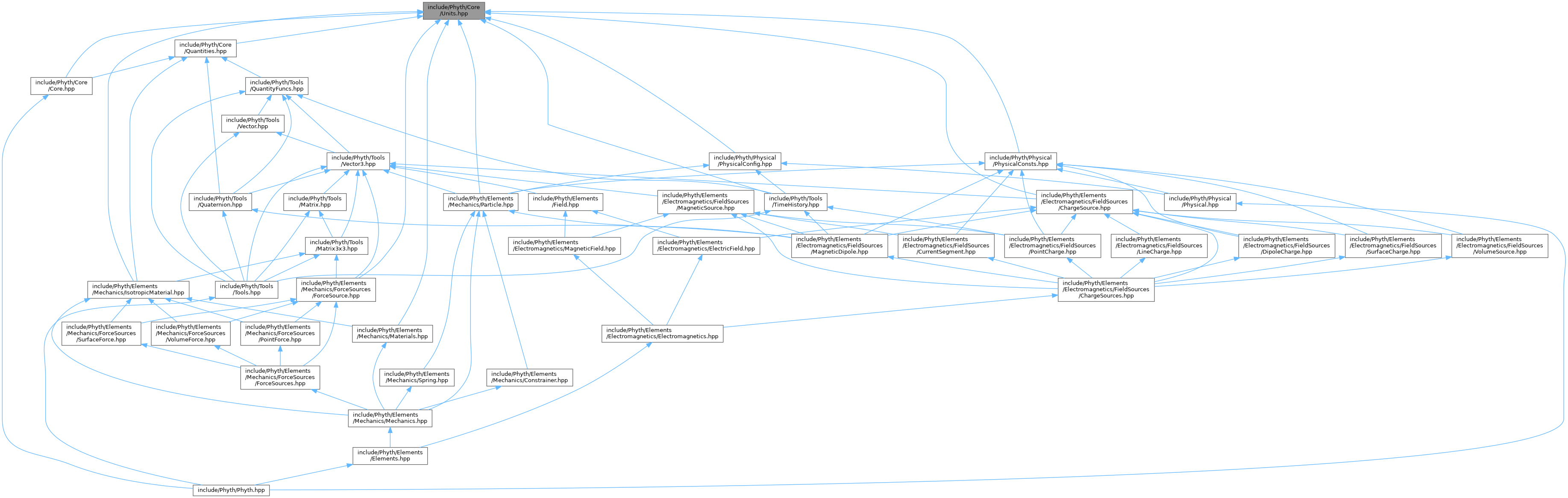
This graph shows which files directly or indirectly include this file:
Go to the source code of this file.
Classes | |
| struct | Phyth::RadianTag |
| struct | Phyth::DegreeTag |
| struct | Phyth::NewtonMeterTag |
| struct | Phyth::VoltagePerMeterTag |
| struct | Phyth::DegreePerSecondTag |
Namespaces | |
| namespace | Phyth |
Macros | |
| #define | PHYTH_CONCAT_IMPL(a, b) a##b |
| #define | PHYTH_CONCAT(a, b) PHYTH_CONCAT_IMPL(a, b) |
| #define | PHYTH_DEFINE_UNIT(dim_type, unit_type, suffix, scale_num, scale_den) |
| Define a unit, literal operator, and registry entry. | |
| #define | PHYTH_DEFINE_UNIT_WITH_NAME(dim_type, unit_type, suffix, scale_num, scale_den, symbol) |
| Same as DEFINE_UNIT with custom display symbol. | |
| #define | PHYTH_DEFINE_UNIT_WITH_TAG(dim_type, unit_type, suffix, scale_num, scale_den, symbol, tag) |
| Define a unit with a tag type for type-safe differentiation. | |
Functions | |
| Phyth::PHYTH_DEFINE_UNIT_WITH_NAME (AngularVelocity, RadianPerSecond, radps, 1, 1, "rad/s") | |
Class Documentation
◆ Phyth::RadianTag
◆ Phyth::DegreeTag
◆ Phyth::NewtonMeterTag
◆ Phyth::VoltagePerMeterTag
◆ Phyth::DegreePerSecondTag
Macro Definition Documentation
◆ PHYTH_CONCAT
| #define PHYTH_CONCAT | ( | a, | |
| b | |||
| ) | PHYTH_CONCAT_IMPL(a, b) |
◆ PHYTH_CONCAT_IMPL
◆ PHYTH_DEFINE_UNIT
| #define PHYTH_DEFINE_UNIT | ( | dim_type, | |
| unit_type, | |||
| suffix, | |||
| scale_num, | |||
| scale_den | |||
| ) |
Value:
using unit_type = Unit<dim_type, std::ratio<scale_num, scale_den>>; \
\
constexpr auto operator""_##suffix(long double x) { \
return Quantity<unit_type>(x); \
} \
\
constexpr auto operator""_##suffix(unsigned long long x) { \
return Quantity<unit_type>(x); \
} \
\
static const Phyth::UnitRegistrar<unit_type> PHYTH_CONCAT(registrar_, unit_type)(#unit_type, #suffix);
Define a unit, literal operator, and registry entry.
This macro creates:
- A unit type alias (e.g., Meter)
- A literal operator (e.g., 1.0_m)
- A static registrar that registers the unit's name and symbol
- Parameters
-
dim_type Dimension type (e.g., Length, Mass) unit_type Unit type name (e.g., Meter, Kilogram) suffix Literal suffix (e.g., m, kg) scale_num Scale numerator relative to base unit scale_den Scale denominator relative to base unit
Example: PHYTH_DEFINE_UNIT(Length, Meter, m, 1, 1) // 1.0_m PHYTH_DEFINE_UNIT(Length, Kilometer, km, 1000, 1) // 1.0_km = 1000 m
◆ PHYTH_DEFINE_UNIT_WITH_NAME
| #define PHYTH_DEFINE_UNIT_WITH_NAME | ( | dim_type, | |
| unit_type, | |||
| suffix, | |||
| scale_num, | |||
| scale_den, | |||
| symbol | |||
| ) |
Value:
using unit_type = Unit<dim_type, std::ratio<scale_num, scale_den>>; \
\
constexpr auto operator""_##suffix(long double x) { \
return Quantity<unit_type>(x); \
} \
\
constexpr auto operator""_##suffix(unsigned long long x) { \
return Quantity<unit_type>(x); \
} \
\
static const Phyth::UnitRegistrar<unit_type> PHYTH_CONCAT(registrar_, unit_type)(#unit_type, symbol);
Same as DEFINE_UNIT with custom display symbol.
- Parameters
-
dim_type Dimension type unit_type Unit type name suffix Literal suffix scale_num Scale numerator scale_den Scale denominator symbol Display symbol (e.g., "m/s", "N/C")
Example: PHYTH_DEFINE_UNIT_WITH_NAME(Velocity, MeterPerSecond, mps, 1, 1, "m/s")
◆ PHYTH_DEFINE_UNIT_WITH_TAG
| #define PHYTH_DEFINE_UNIT_WITH_TAG | ( | dim_type, | |
| unit_type, | |||
| suffix, | |||
| scale_num, | |||
| scale_den, | |||
| symbol, | |||
| tag | |||
| ) |
Value:
using unit_type = Unit<dim_type, std::ratio<scale_num, scale_den>, tag>; \
\
constexpr auto operator""_##suffix(long double x) { \
return Quantity<unit_type>(x); \
} \
\
constexpr auto operator""_##suffix(unsigned long long x) { \
return Quantity<unit_type>(x); \
} \
\
static const Phyth::UnitRegistrar<unit_type> PHYTH_CONCAT(registrar_, unit_type)(#unit_type, symbol);
Define a unit with a tag type for type-safe differentiation.
This is used when two units have the same dimension and scale but represent different physical concepts. For example, Radian and Degree are both dimensionless with scale 1, but they are distinct types.
- Parameters
-
dim_type Dimension type unit_type Unit type name suffix Literal suffix scale_num Scale numerator scale_den Scale denominator symbol Display symbol tag Tag type for type differentiation