Linear elastic isotropic material model. More...
#include <IsotropicMaterial.hpp>
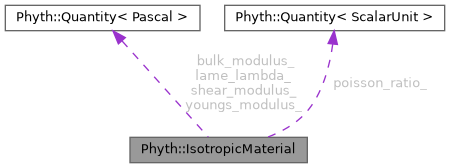
Public Member Functions | |
| IsotropicMaterial ()=default | |
| Default constructor. | |
| IsotropicMaterial (const Quantity< Pascal > youngs_modulus, const Scalar poisson_ratio) | |
| Construct from Young's modulus and Poisson's ratio. | |
| IsotropicMaterial (const Quantity< Pascal > shear_modulus, const Quantity< Pascal > bulk_modulus) | |
| Construct from shear modulus and bulk modulus. | |
| Quantity< Pascal > | GetYoungsModulus () const |
| Get Young's modulus. | |
| Scalar | GetPoissonRatio () const |
| Get Poisson's ratio. | |
| Quantity< Pascal > | GetShearModulus () const |
| Get shear modulus. | |
| Quantity< Pascal > | GetBulkModulus () const |
| Get bulk modulus. | |
| Quantity< Pascal > | GetLameLambda () const |
| Get Lame's first parameter. | |
| Matrix3x3< Quantity< Pascal > > | ComputeStress (const Matrix3x3< Scalar > &strain) const |
| Compute stress tensor from strain tensor. | |
| Matrix3x3< Scalar > | ComputeStrain (const Matrix3x3< Quantity< Pascal > > &stress) const |
| Compute strain tensor from stress tensor. | |
Private Member Functions | |
| void | UpdateDerivedParameters () |
| Update derived parameters from (E, nu) | |
| void | UpdateDerivedParametersFromGK () |
| Update derived parameters from (G, K) | |
Private Attributes | |
| Quantity< Pascal > | youngs_modulus_ |
| Scalar | poisson_ratio_ |
| Quantity< Pascal > | shear_modulus_ |
| Quantity< Pascal > | bulk_modulus_ |
| Quantity< Pascal > | lame_lambda_ |
Detailed Description
Linear elastic isotropic material model.
IsotropicMaterial implements the constitutive relationship for linear elastic materials with direction-independent mechanical properties. The material is fully defined by any two independent elastic constants, with automatic derivation of all other parameters.
The stress-strain relationship follows Hooke's law: sigma_ij = lambda * delta_ij * epsilon_kk + 2 * mu * epsilon_ij
where lambda is Lame's first parameter and mu is the shear modulus.
Supported material parameter pairs for construction:
- (Young's modulus E, Poisson's ratio nu)
- (Shear modulus G, Bulk modulus K)
All quantities maintain physical dimensions through the Quantity system, ensuring dimensional consistency at compile time.
Example: // Steel-like material IsotropicMaterial steel(210.0e9_Pa, 0.3);
// Compute stress from strain Matrix3x3<Scalar> strain = ...; auto stress = steel.ComputeStress(strain);
Definition at line 39 of file IsotropicMaterial.hpp.
Constructor & Destructor Documentation
◆ IsotropicMaterial() [1/3]
|
default |
Default constructor.
Creates an uninitialized material. All elastic moduli are zero. Use this only when the material will be assigned later.
◆ IsotropicMaterial() [2/3]
|
inline |
Construct from Young's modulus and Poisson's ratio.
This is the most common construction method for engineering materials. All other elastic constants (shear modulus G, bulk modulus K, and Lame's first parameter lambda) are derived automatically.
Valid range: -1 < nu < 0.5 for thermodynamic stability
- nu > 0.5: material becomes incompressible or auxetic
- nu < -1: violates stability criteria
- Parameters
-
youngs_modulus Young's modulus E (Pa) poisson_ratio Poisson's ratio nu (dimensionless)
Definition at line 63 of file IsotropicMaterial.hpp.
◆ IsotropicMaterial() [3/3]
|
inline |
Construct from shear modulus and bulk modulus.
This construction method is useful when the material properties are derived from wave propagation measurements or high-pressure experiments.
All other constants (Young's modulus E, Poisson's ratio nu, and Lame's first parameter lambda) are derived automatically.
- Parameters
-
shear_modulus Shear modulus G (Pa), must be positive bulk_modulus Bulk modulus K (Pa), must be positive
Definition at line 81 of file IsotropicMaterial.hpp.
Member Function Documentation
◆ ComputeStrain()
|
inline |
Compute strain tensor from stress tensor.
Implements the inverse form of Hooke's law: epsilon_ij = (1 + nu) / E * sigma_ij - nu / E * trace(sigma) * delta_ij
This is the compliance form of the constitutive relationship, useful for displacement-based formulations.
- Parameters
-
stress Stress tensor in pascals (symmetric)
- Returns
- Strain tensor (dimensionless, symmetric)
Example: Matrix3x3<Quantity<Pascal>> stress; stress(0, 0) = 100.0e6_Pa; // uniaxial tension auto strain = material.ComputeStrain(stress);
Definition at line 166 of file IsotropicMaterial.hpp.
◆ ComputeStress()
|
inline |
Compute stress tensor from strain tensor.
Implements the generalized Hooke's law for isotropic materials: sigma_ij = lambda * trace(epsilon) * delta_ij + 2 * mu * epsilon_ij
The strain tensor is expected to represent infinitesimal strain (small deformation theory). For finite strain, use appropriate hyperelastic models instead.
- Parameters
-
strain Strain tensor (dimensionless, symmetric)
- Returns
- Stress tensor in pascals (symmetric)
Example: Matrix3x3<Scalar> strain; strain(0, 0) = 0.001; // 0.1% axial strain auto stress = material.ComputeStress(strain);
Definition at line 134 of file IsotropicMaterial.hpp.
◆ GetBulkModulus()
Get bulk modulus.
- Returns
- Bulk modulus K in pascals
Definition at line 108 of file IsotropicMaterial.hpp.
◆ GetLameLambda()
Get Lame's first parameter.
- Returns
- Lame's first parameter lambda in pascals
Definition at line 114 of file IsotropicMaterial.hpp.
◆ GetPoissonRatio()
|
inline |
Get Poisson's ratio.
- Returns
- Poisson's ratio nu (dimensionless)
Definition at line 96 of file IsotropicMaterial.hpp.
◆ GetShearModulus()
Get shear modulus.
- Returns
- Shear modulus G in pascals
Definition at line 102 of file IsotropicMaterial.hpp.
◆ GetYoungsModulus()
Get Young's modulus.
- Returns
- Young's modulus E in pascals
Definition at line 90 of file IsotropicMaterial.hpp.
◆ UpdateDerivedParameters()
|
inlineprivate |
Update derived parameters from (E, nu)
Relations: G = E / (2 * (1 + nu)) K = E / (3 * (1 - 2 * nu)) lambda = E * nu / ((1 + nu) * (1 - 2 * nu))
Note: These formulas are singular for nu = 0.5 (incompressible limit) and nu = -1 (stability limit).
Definition at line 202 of file IsotropicMaterial.hpp.
◆ UpdateDerivedParametersFromGK()
|
inlineprivate |
Update derived parameters from (G, K)
Relations: E = 9 * G * K / (3 * K + G) nu = (3 * K - 2 * G) / (2 * (3 * K + G)) lambda = K - 2/3 * G
This formulation is more stable near the incompressible limit.
Definition at line 218 of file IsotropicMaterial.hpp.
Member Data Documentation
◆ bulk_modulus_
Definition at line 188 of file IsotropicMaterial.hpp.
◆ lame_lambda_
Definition at line 189 of file IsotropicMaterial.hpp.
◆ poisson_ratio_
|
private |
Definition at line 185 of file IsotropicMaterial.hpp.
◆ shear_modulus_
Definition at line 187 of file IsotropicMaterial.hpp.
◆ youngs_modulus_
Definition at line 184 of file IsotropicMaterial.hpp.
The documentation for this class was generated from the following file:
- include/Phyth/Elements/Mechanics/IsotropicMaterial.hpp