Spring constraint between two particles. More...
#include <Spring.hpp>
Static Private Member Functions | |
| static void | validateRestLength (const Quantity< Meter > &length) |
| static void | validateStiffness (const Quantity< NewtonPerMeter > &stiffness) |
| static void | validateDamping (const Quantity< KilogramPerSecond > &damping) |
Private Attributes | |
| std::shared_ptr< Particle > | p1_ |
| std::shared_ptr< Particle > | p2_ |
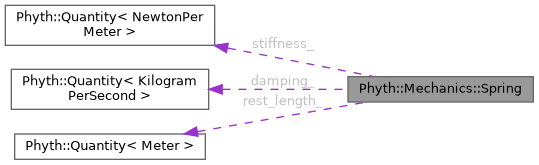
| Quantity< NewtonPerMeter > | stiffness_ |
| Quantity< KilogramPerSecond > | damping_ |
| Quantity< Meter > | rest_length_ |
Detailed Description
Spring constraint between two particles.
Spring applies a Hooke's law force between two particles: F = -k * (current_length - rest_length) * direction
Additionally, a damping force proportional to the relative velocity along the spring axis can be added: F_damp = -c * (v1 - v2) · direction
The spring is bi-directional: equal and opposite forces are applied to both particles. If one particle is fixed, the other still moves correctly.
Example: auto p1 = std::make_shared<Particle>(1_kg, Vector3{0_m, 0_m, 0_m}); auto p2 = std::make_shared<Particle>(1_kg, Vector3{1_m, 0_m, 0_m});
Spring spring(p1, p2, 10.0_N/m, 0.5_kgps);
// In simulation loop: spring.Constrain();
auto energy = spring.GetElasticEnergy(); // 1/2 * k * elongation^2
Definition at line 37 of file Spring.hpp.
Constructor & Destructor Documentation
◆ Spring()
|
inline |
Construct a spring between two particles.
- Parameters
-
p1 First particle (force applied in direction p2->p1) p2 Second particle (force applied in direction p1->p2) stiffness Spring constant k (N/m) damping Damping coefficient c (kg/s), default 0
The rest length is automatically set to the initial distance between the two particles.
- Exceptions
-
std::invalid_argument If rest length <= 0, stiffness < 0, or damping < 0
Definition at line 53 of file Spring.hpp.
Member Function Documentation
◆ Constrain()
|
inline |
Apply spring and damping forces to both particles (Force Constrain)
The spring force is: F = k * (current_length - rest_length) * direction
If damping > 0, an additional damping force is applied: F_damp = c * (v1 - v2) · direction
Both forces are applied in opposite directions to p1 and p2.
Definition at line 76 of file Spring.hpp.
◆ GetCurrentLength()
- Returns
- Current distance between the two particles
Definition at line 116 of file Spring.hpp.
◆ GetDamping()
|
inline |
- Returns
- Damping coefficient c (kg/s)
Definition at line 113 of file Spring.hpp.
◆ GetElasticEnergy()
Compute the elastic potential energy stored in the spring.
- Returns
- 1/2 * k * elongation^2 (Joules)
Definition at line 161 of file Spring.hpp.
◆ GetElongation()
- Returns
- Current elongation (current_length - rest_length)
Definition at line 121 of file Spring.hpp.
◆ GetEnergyDensity()
Compute energy per unit length.
- Returns
- ElasticEnergy / CurrentLength (Newtons)
Note: If current_length is zero, this will produce a division by zero. Caller should ensure the particles are separated.
Definition at line 174 of file Spring.hpp.
◆ GetParticle1()
- Returns
- Shared pointer to the first particle
Definition at line 101 of file Spring.hpp.
◆ GetParticle2()
- Returns
- Shared pointer to the second particle
Definition at line 104 of file Spring.hpp.
◆ GetRestLength()
- Returns
- Current rest length (constant unless modified)
Definition at line 107 of file Spring.hpp.
◆ GetStiffness()
|
inline |
- Returns
- Spring stiffness constant k (N/m)
Definition at line 110 of file Spring.hpp.
◆ SetDamping()
|
inline |
Set a new damping coefficient.
- Parameters
-
damping New damping coefficient (must be non-negative)
- Exceptions
-
std::invalid_argument If damping < 0
Definition at line 151 of file Spring.hpp.
◆ SetRestLength()
Set a new rest length.
- Parameters
-
rest_length New rest length (must be positive finite)
- Exceptions
-
std::invalid_argument If rest_length <= 0
Definition at line 129 of file Spring.hpp.
◆ SetStiffness()
|
inline |
Set a new stiffness.
- Parameters
-
stiffness New stiffness (must be non-negative)
- Exceptions
-
std::invalid_argument If stiffness < 0
Definition at line 140 of file Spring.hpp.
◆ validateDamping()
|
inlinestaticprivate |
Definition at line 198 of file Spring.hpp.
◆ validateRestLength()
|
inlinestaticprivate |
Definition at line 186 of file Spring.hpp.
◆ validateStiffness()
|
inlinestaticprivate |
Definition at line 192 of file Spring.hpp.
Member Data Documentation
◆ damping_
|
private |
Definition at line 183 of file Spring.hpp.
◆ p1_
|
private |
Definition at line 179 of file Spring.hpp.
◆ p2_
|
private |
Definition at line 180 of file Spring.hpp.
◆ rest_length_
Definition at line 184 of file Spring.hpp.
◆ stiffness_
|
private |
Definition at line 182 of file Spring.hpp.
The documentation for this class was generated from the following file:
- include/Phyth/Elements/Mechanics/Spring.hpp