Ideal electric dipole with zero net charge. More...
#include <DipoleCharge.hpp>
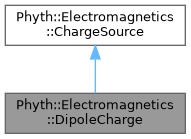
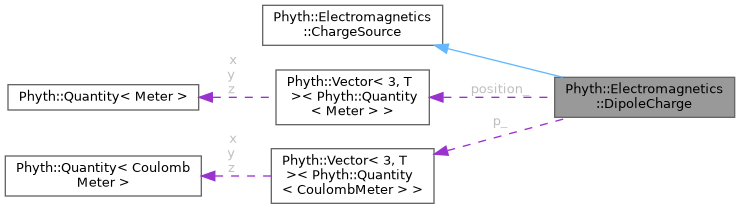
 Public Member Functions inherited from
Private Attributes | |
| Vector3< Quantity< Meter > > | position_ |
| Vector3< Quantity< CoulombMeter > > | p_ |
Detailed Description
Ideal electric dipole with zero net charge.
DipoleCharge represents an ideal point electric dipole. It has zero net charge (total charge = 0) but produces a non-zero electric field and potential due to the separation of positive and negative charges.
The dipole is defined by its position and dipole moment vector p, which points from the negative to the positive charge.
Example: auto pos = Vector3<Quantity<Meter>>(0_m, 0_m, 0_m); auto p = Vector3<Quantity<CoulombMeter>>(1.0_C*m, 0_C*m, 0_C*m); DipoleCharge dipole(pos, p);
auto point = Vector3<Quantity<Meter>>(1.0_m, 0_m, 0_m); auto E = dipole.GetElectricFieldAt(point); auto V = dipole.GetElectricPotentialAt(point);
- Note
- : The field diverges at the dipole location. Querying the field at the dipole position throws an exception.
Definition at line 30 of file DipoleCharge.hpp.
Constructor & Destructor Documentation
◆ DipoleCharge()
|
inline |
Construct an electric dipole.
- Parameters
-
position Location of the dipole (meters) dipole_moment Dipole moment vector p (C*m)
Definition at line 38 of file DipoleCharge.hpp.
Member Function Documentation
◆ GetDipoleMoment()
|
inline |
- Returns
- The dipole moment vector p (C*m)
Definition at line 110 of file DipoleCharge.hpp.
◆ GetElectricFieldAt()
|
inlineoverridevirtual |
Compute the electric field of the dipole.
The field at point r (relative to the dipole) is: E = k_E * (3 * (p dot hat_r) * hat_r - p) / r^3
- Parameters
-
point Position to evaluate the field (meters)
- Returns
- Electric field intensity E (N/C)
- Exceptions
-
std::runtime_error If point is at the dipole location
Implements Phyth::Electromagnetics::ChargeSource.
Definition at line 55 of file DipoleCharge.hpp.
◆ GetElectricPotentialAt()
|
inlineoverridevirtual |
Compute the electric potential of the dipole.
The potential at point r (relative to the dipole) is: V = k_E * (p dot hat_r) / r^2
- Parameters
-
point Position to evaluate the potential (meters)
- Returns
- Electric potential V (Volts)
- Exceptions
-
std::runtime_error If point is at the dipole location
Implements Phyth::Electromagnetics::ChargeSource.
Definition at line 78 of file DipoleCharge.hpp.
◆ GetMinimumDistanceTo()
|
inlineoverridevirtual |
Get the minimum distance from a point to the dipole location.
- Parameters
-
point Position to compute distance from
- Returns
- Distance from the point to the dipole location (meters)
Implements Phyth::Electromagnetics::ChargeSource.
Definition at line 105 of file DipoleCharge.hpp.
◆ GetTotalChargeValue()
|
inlineoverridevirtual |
Get the total charge of the dipole.
- Returns
- 0_C (an ideal dipole has zero net charge)
Implements Phyth::Electromagnetics::ChargeSource.
Definition at line 94 of file DipoleCharge.hpp.
Member Data Documentation
◆ p_
|
private |
Definition at line 116 of file DipoleCharge.hpp.
◆ position_
Definition at line 115 of file DipoleCharge.hpp.
The documentation for this class was generated from the following file:
- include/Phyth/Elements/Electromagnetics/FieldSources/DipoleCharge.hpp