Abstract base class for all charge distributions. More...
#include <ChargeSource.hpp>
Public Member Functions | |
| virtual | ~ChargeSource ()=default |
| virtual Vector3< Quantity< NewtonPerCoulomb > > | GetElectricFieldAt (const Vector3< Quantity< Meter > > &point) const =0 |
| Compute the electric field at a point. | |
| virtual Quantity< Volt > | GetElectricPotentialAt (const Vector3< Quantity< Meter > > &point) const =0 |
| Compute the electric potential at a point. | |
| virtual Quantity< Coulomb > | GetTotalChargeValue () const =0 |
| Get the total charge of this source. | |
| virtual Quantity< CoulombPerCubicMeter > | GetChargeDensityAt (const Vector3< Quantity< Meter > > &point) const |
| Get the charge density at a point. | |
| virtual Quantity< Meter > | GetMinimumDistanceTo (const Vector3< Quantity< Meter > > &point) const =0 |
| Get the minimum distance from a point to this charge source. | |
Detailed Description
Abstract base class for all charge distributions.
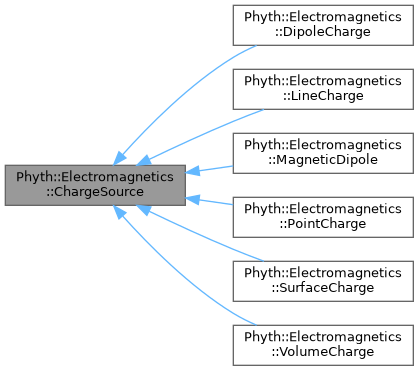
ChargeSource defines the interface for any charge distribution that produces an electric field and potential. Subclasses represent specific geometries such as point charges, line charges, surface charges, volume charges, or dipoles.
The interface provides methods for computing:
- Electric field E at a point
- Electric potential V at a point
- Total charge (integrated over the source)
- Charge density at a point (for distributed sources)
- Minimum distance from a point to the source (for regularization)
Example: class PointCharge : public ChargeSource { // Implements GetElectricFieldAt, GetElectricPotentialAt, // GetTotalChargeValue, GetMinimumDistanceTo };
Definition at line 30 of file ChargeSource.hpp.
Constructor & Destructor Documentation
◆ ~ChargeSource()
|
virtualdefault |
Member Function Documentation
◆ GetChargeDensityAt()
|
inlinevirtual |
Get the charge density at a point.
- Parameters
-
point Position in 3D space (meters)
- Returns
- Charge density (C/m^3)
The default implementation returns zero for non-distributed sources (point charges, dipoles). Subclasses for distributed sources (line, surface, volume charges) should override this.
Reimplemented in Phyth::Electromagnetics::VolumeCharge.
Definition at line 79 of file ChargeSource.hpp.
◆ GetElectricFieldAt()
|
pure virtual |
Compute the electric field at a point.
- Parameters
-
point Position in 3D space (meters)
- Returns
- Electric field intensity E (N/C) as a Vector3
For point charges, this uses Coulomb's law. For distributed charges, this integrates over the source geometry.
Implemented in Phyth::Electromagnetics::DipoleCharge, Phyth::Electromagnetics::LineCharge, Phyth::Electromagnetics::MagneticDipole, Phyth::Electromagnetics::PointCharge, Phyth::Electromagnetics::SurfaceCharge, and Phyth::Electromagnetics::VolumeCharge.
◆ GetElectricPotentialAt()
|
pure virtual |
Compute the electric potential at a point.
- Parameters
-
point Position in 3D space (meters)
- Returns
- Electric potential V (Volts)
For point charges, this uses V = k * q / r. For distributed charges, this integrates over the source geometry.
Implemented in Phyth::Electromagnetics::DipoleCharge, Phyth::Electromagnetics::LineCharge, Phyth::Electromagnetics::MagneticDipole, Phyth::Electromagnetics::PointCharge, Phyth::Electromagnetics::SurfaceCharge, and Phyth::Electromagnetics::VolumeCharge.
◆ GetMinimumDistanceTo()
|
pure virtual |
Get the minimum distance from a point to this charge source.
- Parameters
-
point Position in 3D space (meters)
- Returns
- Minimum distance (meters)
This is used for regularization in field computations to avoid singularities. For point charges, this returns the distance to the point charge location. For extended sources, this returns the distance to the nearest point on the source geometry.
Implemented in Phyth::Electromagnetics::DipoleCharge, Phyth::Electromagnetics::LineCharge, Phyth::Electromagnetics::MagneticDipole, Phyth::Electromagnetics::PointCharge, Phyth::Electromagnetics::SurfaceCharge, and Phyth::Electromagnetics::VolumeCharge.
◆ GetTotalChargeValue()
|
pure virtual |
Get the total charge of this source.
- Returns
- Total charge (Coulombs)
For point charges, this is the charge value itself. For distributed charges, this is the integral of charge density.
Implemented in Phyth::Electromagnetics::DipoleCharge, Phyth::Electromagnetics::LineCharge, Phyth::Electromagnetics::MagneticDipole, Phyth::Electromagnetics::PointCharge, Phyth::Electromagnetics::SurfaceCharge, and Phyth::Electromagnetics::VolumeCharge.
The documentation for this class was generated from the following file:
- include/Phyth/Elements/Electromagnetics/FieldSources/ChargeSource.hpp